
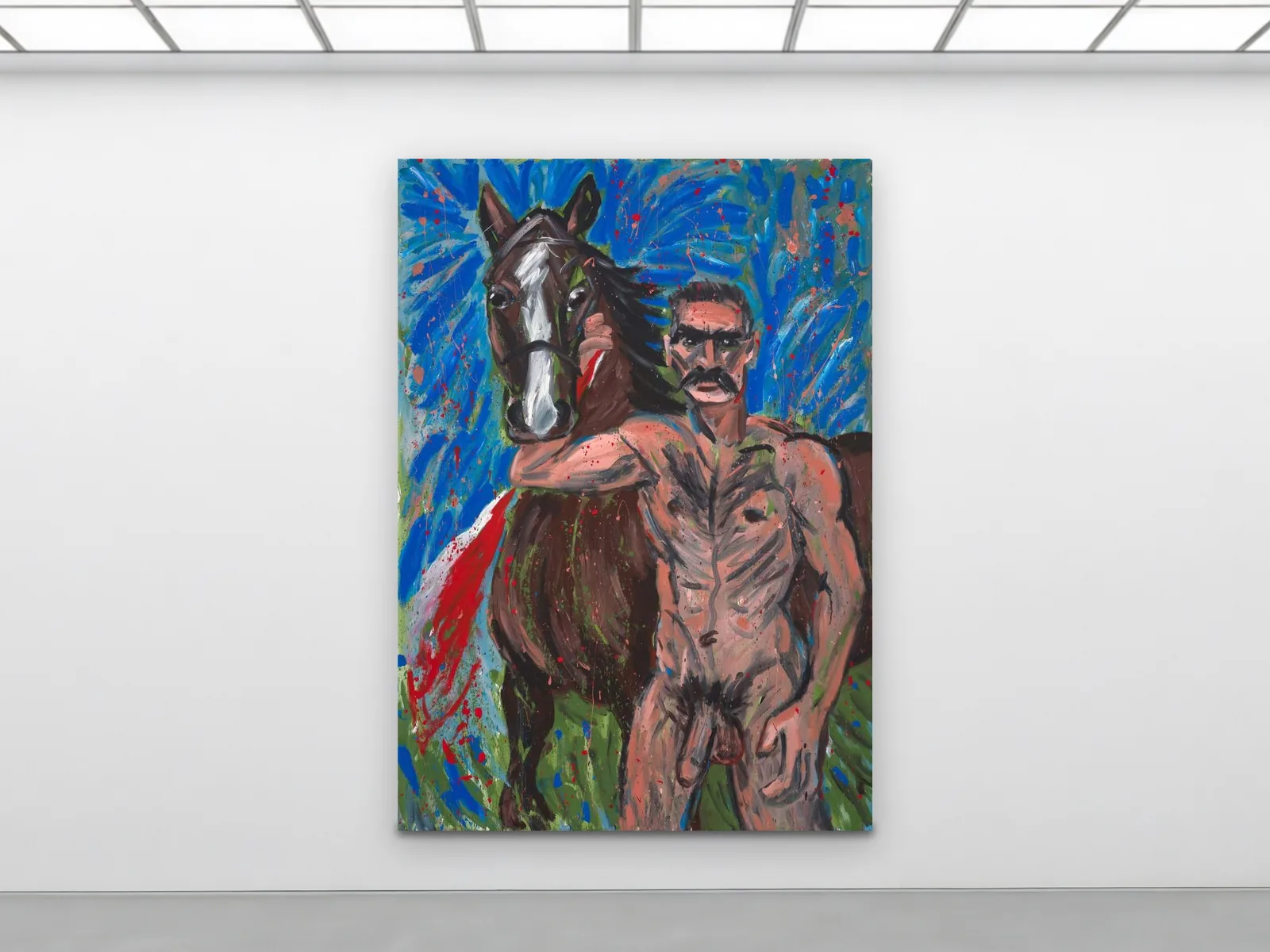
Reproductions of Wojciech Kossak's painting Józef Piłsudski na Kasztance (Józef Piłsudski on Kasztanka) hung in countless homes in interwar Poland, the Second Republic. They were a tribute to Piłsudski, a mark of respect. For the same reason Kasztanka with the Marshal hangs in my home, which at first glance may look like a provocation, but only at first glance. Simply reversing the traditional order, so that Kasztanka comes first in the title and Piłsudski second, brings a lot of warmth and affection. The Marshal loved his mare, so he would certainly not have taken offence. He might have needed a moment to get used to the scene in the lower part of the painting, but within Karol's queer retelling of history Piłsudski is decidedly a positive figure. One reason is the decision to stop punishing homosexual acts, which was by no means obvious in the Europe of the time. Article 516 of the Russian Tagantsev code of 1903 stated: "A person guilty of pederasty shall be punished by imprisonment for a term of no less than three months." Paragraph 175 of the German Strafgesetzbuch (StGB) of 1871 declared flatly: "Unnatural fornication committed between persons of the male sex, or between a human being and an animal, shall be punished by imprisonment, with the possible loss of civil rights." The Polish penal code of 1932, passed while Piłsudski was in effective charge of the country, did not punish homosexual relations unless they bore the hallmarks of prostitution. Germany did not soften its law until 1969, 37 years after Poland and Piłsudski. That is why, for me, this painting is a portrait of a calm man who has seen a great deal and managed to survive. His faithful mare lifts her muzzle, catching a breath of cool wind among the fields. It is an intimate scene, full of the warmth between a man and an animal who, in this one moment, are truly free.
The painter
Karol Radziszewski (born 1980) is a defining figure of queer art in Poland, founder of the Queer Archives Institute and a Polityka Passport laureate. He reads Polish history through a queer lens, turning monumental figures back into people you can come close to, and his work is held by museums in Poland and abroad.